On January 30th, 2024, the Bluetooth authentication process was updated, and the board of directors of Bluetooth SIG approved the upcoming revision of the Bluetooth authentication process in the latest draft of QPRDv3 (QPRD_PROC_d3r15). The new process will be simplified, the inconsistency between management documents and operation documents will be solved, and the process documents will be merged into a single document: QPRDv3.
The qualification plan reference document (QPRD)v3 is scheduled to take effect on July 1, 2024 after it was finally approved by the Bluetooth SIG Board of Directors on June 11, 2024.
Overview of the changes in the new version of (QPRD)v3
1. Document integration: the compliance requirements in PRD, DPD and core specifications are integrated, and the process documents are merged into a single document, namely (QPRD)v3;;
2. User scenario improvement: the authentication path is improved according to the user scenario, which makes the authentication process closer to the actual needs;
3. Replacing Product Types with core configuration: replacing product types with core configuration and introducing new collocation rules;
4. Terminology updating: updating terminology to maintain consistency, such as changing Qualified Design ID(QDID) to Design Number (DN);
5. Test requirements: Implement unified and clear test requirements, and simplify the test plan by generating only the required tests;
6. Cancel the repeated evaluation: cancel the requirement of re-evaluation of the three-year validity period, and reduce the certification cost and time cost of the enterprise;
7. Interoperability improvement: product interoperability is enhanced through IOPT and interlayer dependency, and the compatibility of Bluetooth devices is improved;
8. Enhance readability: By using step-by-step guidance and clear tables to explain policies, the readability of documents is enhanced;
9. Increase flexibility: It provides greater flexibility for users to control and manage their products and designs.
10. Add an appendix: provide transition guidance for qualified products with PRD version 2.3 or earlier.
Product certification process under the New Deal
1. Providing product details: First, members need to provide detailed product information to certification bodies, including product specifications, functions, etc.
2. Designation information: With the help of QPRD v3 and new authentication tools, members need to specify the design information of products. According to whether the product adopts new features or follows the existing design, members will choose the appropriate configuration from multiple options;
3. Payment of administrative fees: After the designation of design information is completed, members need to pay administrative fees (that is, the fees after renaming the original Declaration Fee);
4. Submit certification items: After paying the fees, members will submit complete certification items, including all necessary documents and test reports;
5. Waiting for the audit result: The certification body will audit the submitted items and inform the members of the results after the audit is completed.
Major changes in the new version of (QPRD) v3
This update has greatly changed the process of applying for Bluetooth qualification certification. The most important changes are as follows:
01 Changes in certification fees:
Rate unchanged: Although the terminology has been adjusted, the actual certification fee has not changed. The original "Declaration Fee" is now renamed as "Administrative Fee", but the fee amount remains unchanged.
02 Qualified Design ID (QDID) change:
◆ Change to Design Number (DN): The identification number of Bluetooth design is changed from the original Qualified Design ID (QDID) to Design Number (DN). The function of DN is similar to QDID, allowing other members to quote it to complete further authentication.
◆ Supplier's responsibility: The supplier needs to provide the DN of the products sold to the downstream customers, so that the downstream customers can complete the certification of their own products based on the DN.
03 Cancel Product Types:
◆ alternative: old Product Types such as end product, controller subsystem, host subsystem and profile subsystem will no longer be applicable. Instead, it is core configuration, which is divided into three categories: BR/EDR core configuration, LE core configuration and BR/EDR/LE core configuration. Each configuration layer is divided into mandatory, conditional and optional. In addition, two layers of security mechanisms, LESEC and SEC, are added.
◆ Impact: This change means that from July 1, 2024, the newly issued product certification certificate will no longer show the product type. Members need to understand and describe their products based on core configuration and available collocation.
04 Practical details of the change of new product listing rules (including chip manufacturers and whole machine product vendors)
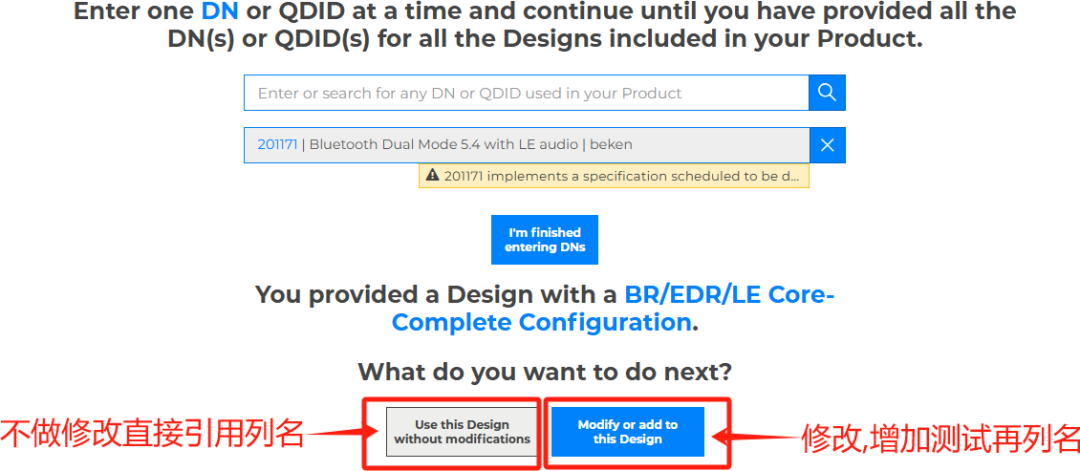
The operation process of online listing has been completely changed, and I believe everyone is familiar with it. The following is the related introduction to the second step, "Specify the Design":
◆ The second step "Specify the Design" has two options: one is to directly reference the column name for the referenced QDID(DN) number without any modification, which is similar to the old version of No report Listing;; Second, the reference QDID number has been modified, and this needs to be re-tested to upload the report for column name, similar to with report Listing, as shown in the following figure:
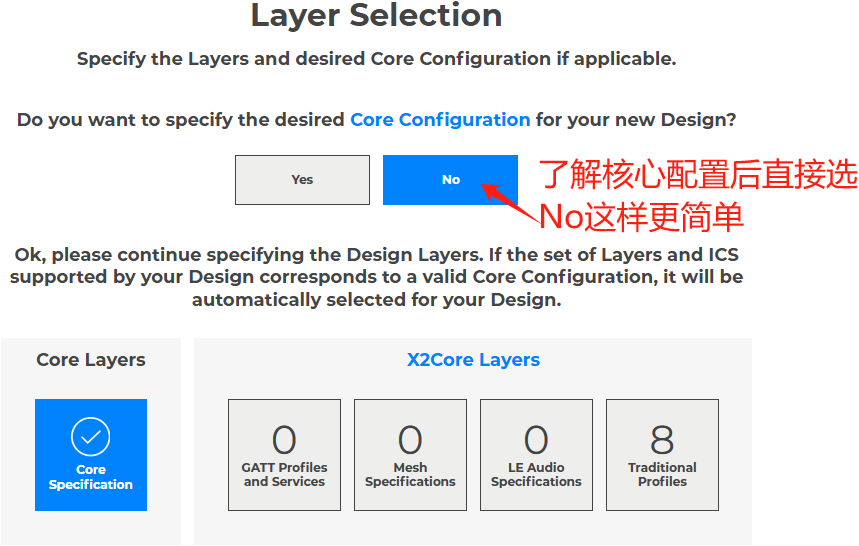
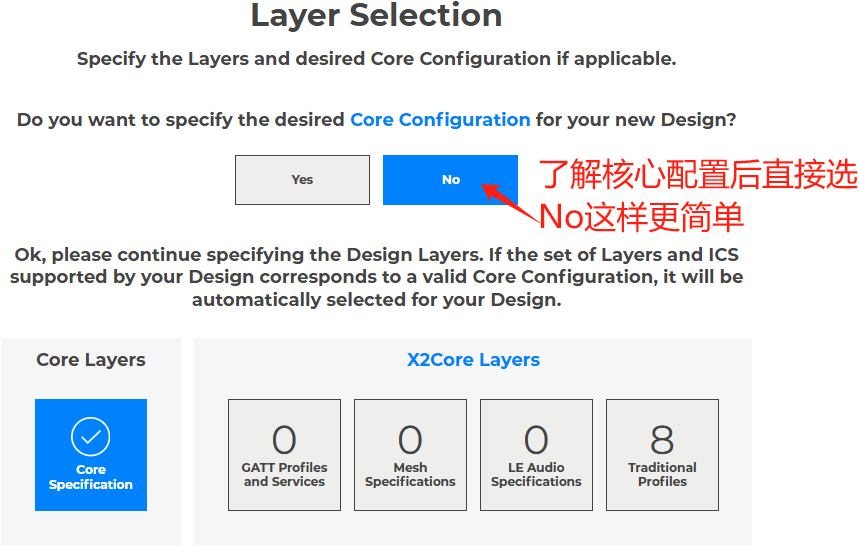
◆ Further down is "Layer Selection", which is divided into Core Layers and X2Core Layers. Actually, it is the core configuration layer and application layer. Try not to change it according to the core configuration, just use the reference chip QDID by default. Check the X2Core Layers layer according to the actual situation of the product, and remember to click after the check is completed  Otherwise, it may not have been updated.
◆ The next step of "ICS Selection ICS Selection" is the biggest difference from the previous one: if any layer of configuration is unlocked, it must be retested to provide test evidence. The old ICS selection can be subtracted, that is, if it is not supported, it can be deleted freely. It is not supported and does not need to be retested. This change in the new version has led to many problems in the column names. For example, the chip function of the chip factory supports the dual-mode of BR/EDR/LE, but only the single-mode of BR/EDR or LE is used when it is given to the downstream end customers, so the problem of core configuration reporting occurs when Consistency check is done.
Now, a new "Test Coverage Waiver (TCW)" has been added. Members can log in through the link to submit some test exemption applications, and the expert group will discuss them. If they think it is reasonable, they can be exempted from accidents, but this process is also relatively long.
Warm tips
ZRLK has been focusing on the testing and certification of consumer electronic and electrical products for 20 years, always paying attention to the changes of laws and regulations in various countries, and providing customers with one-stop testing and certification services to ensure that your products enter the target market quickly. If you want to know more about the requirements of Bluetooth BQB certification or have products that need Bluetooth BQB certification, please feel free to contact us, and our engineers will serve you as soon as possible!